
AAC 2026: How social media led to an FA diagnosis, and patient advocacy
College student now uses online tools to raise awareness, offer support
Written by |




Alyssa Hammers and her healthcare providers had been trying to determine the cause of her coordination problems, without success. Then, her cousin showed her a TikTok video about living with Friedreich’s ataxia (FA).
Hammers immediately recognized the similarities to her symptoms.
Despite initial skepticism from her neurologist, Hammers was soon diagnosed with FA in February 2021.
Although managing a rare, chronic condition hasn’t been easy, Hammers has found fulfillment through exercise, work, and social connection.
She also recently attended the 2026 Annual Ataxia Conference in Orlando, Florida, where she had the chance to connect with others living with ataxia.
“I love the research and the panels,” she said. “You learn a lot, but I really enjoy meeting people who know exactly what it’s like navigating life with ataxia.”
The path to an FA diagnosis through self-advocacy
After watching the TikTok video, Hammers researched FA online and shared her findings with her parents. But they weren’t convinced she had the rare condition.
“Dr. Google is not going to fix your problems,” Hammers recalls them saying.
Her neurologist also was doubtful. She suspected a vitamin deficiency.
But Hammers, who was 19 at the time, advocated for herself and insisted on getting tested. And indeed, those tests showed that she had FA.
Hammers was angry after her FA diagnosis was confirmed. “It just felt like a nightmare that I wasn’t waking up from,” she said.
The value of exercise, assistive devices, and social support
It can be very challenging to cope with FA symptoms, which for Hammers primarily involves balance and coordination issues, and, some days, fatigue. However, she says consistent exercise has made a big difference in managing her condition.
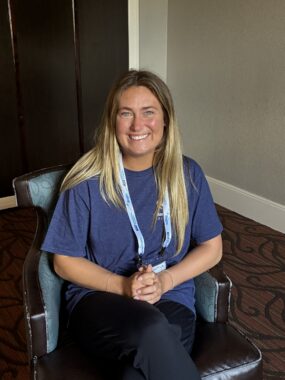
Alyssa Hammers takes time out from AAC for an interview with Bionews. (By Agata Boxe)
“I think that has tremendously helped with keeping my progression very limited,” said Hammers, who is now 24 and lives in Omaha, Nebraska.
Hammers is dedicated to her exercise routine. She works out six days a week, at 5 o’clock in the morning. Her training prioritizes lifting weights.
She has also recently started using a walker, which she has found very helpful.
“I’ve only noticed good things since transitioning into it,” she said.
Another key aspect of managing life with the condition has been the support from her family, friends, and ataxia peers she has met through the local support group Ataxia Connection.
Its members meet monthly, virtually or in person. They also hold “Birds of a Feather” sessions for patients and caregivers, where the two groups meet in separate rooms to discuss their experiences.
Ataxia awareness and social media
In addition to studying communications and working part-time at a daycare, Hammers is a part-time program and communications coordinator for Ataxia Connection.
In her role with the organization, Hammers handles the marketing, social media, and other forms of communications to share information about fundraising events and social outings.
Her job with Ataxia Connection allows her to cultivate her passion for social media, which grew out of her experience with the TikTok video.
Coincidentally, the video was made by Kiersten Riggs, who is also living with FA and now working as a social growth manager at Bionews, the publisher of Friedreich’s Ataxia News. Riggs attended this year’s AAC as well.
Hammers also uses social media to raise FA awareness outside of work.
“Awareness brings understanding,” she said. “Understanding makes us feel comfortable.”
Through her advocacy, Hammers is helping build that understanding — one social post at a time.
Note: The Friedreich’s Ataxia News team is providing live coverage of the 2026 Annual Ataxia Conference April 9-11 in Orlando, Florida. Go here to see the latest stories from the conference.


Leave a comment
Fill in the required fields to post. Your email address will not be published.