
What is Friedreich’s ataxia?
 Reviewed by
Friedreich’s ataxia (FA) is a rare inherited disease that gradually affects movement, balance, and coordination. It primarily affects the nervous system and can also cause heart problems, changes in the spine and feet, and diabetes. Symptoms often begin between ages 5 and 15, though they can start in adulthood.
FA affects an estimated 1 in 30,000 to 1 in 50,000 people in the U.S., though estimates vary by population and region. It is the most common inherited form of ataxia, a condition that affects coordination.
What is Friedreich’s ataxia?
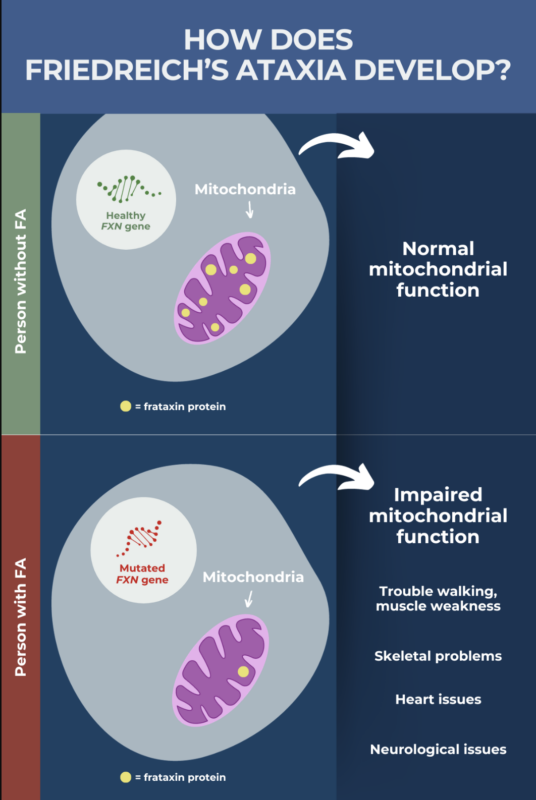
Ataxia means difficulty coordinating movement. In FA, it develops because the body makes too little of a protein called frataxin. Frataxin helps mitochondria — the structures that supply cells with energy — use iron to make proteins needed for energy production. Without enough frataxin, mitochondria have trouble using iron and producing energy.
Nerve and heart muscle cells are especially vulnerable because they need a lot of energy. Damage to nerves that carry signals about body position can make it harder to balance and coordinate movements.
Low frataxin can also increase oxidative stress, a process that can damage cells. FA affects parts of the spinal cord, peripheral nerves, and cerebellum, a part of the brain that helps coordinate movement.
What causes FA?
The genetic changes that cause Friedreich’s ataxia occur in the FXN gene, which provides instructions for making frataxin. In most people with FA, a three-letter DNA sequence (GAA) appears too many times in both copies of the gene. A typical copy has 5 to 33 repeats. Intermediate copies have 34 to 65 repeats, and disease-causing expansions generally have 66 to about 1,300 repeats.
The extra repeats make it harder for the cell to read the gene’s instructions. Longer expansions generally lead to lower frataxin levels and are associated with earlier symptoms, though the rate of progression varies even among people with similar repeat lengths. Some people inherit a repeat expansion in one copy of FXN and a different disease-causing change in the other.
How is FA inherited?
FA is autosomal recessive, meaning a person with the condition inherits a disease-causing FXN mutation from each biological parent. People with one changed copy are called carriers and generally have no symptoms.
Carrier frequency varies by ancestry and region. Estimates across European populations range from about 1 in 60 to 1 in 500. A genetic counselor can help relatives of someone with FA decide whether to get carrier testing and explain what the results mean for family planning, ideally before pregnancy.
These inheritance chances apply to each pregnancy.
Scroll horizontally to view all columns -->
| Parents’ genetic status | Child has FA | Child is a carrier | Child inherits neither change |
|---|---|---|---|
| Both parents are carriers | 25% | 50% | 25% |
| One parent has FA and the other is a carrier | 50% | 50% | 0% |
| One parent has FA, and the other is neither affected nor a carrier | 0% | 100% | 0% |
What are the symptoms of FA?
Friedreich’s ataxia symptoms vary from person to person. Trouble walking or keeping balance is often the first noticeable change. Heart or spine problems can appear early, sometimes before movement symptoms.
Early symptoms
- Unsteady walking, frequent stumbling, or difficulty balancing
- Leg weakness, reduced ability to feel vibration or foot position, and reduced or absent reflexes
- Scoliosis (a sideways curve in the spine)
- Foot changes such as high arches
- Thickening of the heart muscle (hypertrophic cardiomyopathy), which heart tests may detect before symptoms appear
Symptoms as FA progresses
- Increasing weakness and difficulty coordinating the arms and hands
- Slower or slurred speech and, in some people, trouble swallowing
- Changes in vision or hearing
- Muscle tightness (spasticity)
- Bladder and bowel problems such as urinary urgency, constipation, or incontinence
- Heart rhythm problems or heart failure
- Diabetes
Many people need a wheelchair within 10 to 20 years of symptom onset, though the timing varies.
Some people also experience sexual difficulties, including reduced genital sensation, erectile dysfunction, or vaginal dryness. Diabetes can develop when the body makes too little insulin or has trouble using it to control blood sugar.
How is FA diagnosed?
Genetic testing is the first-line test to confirm a Friedreich’s ataxia diagnosis when symptoms and an exam suggest FA. A blood test can look for GAA repeat expansions in the FXN gene. If an expansion in just one copy is found, the lab can look for other disease-causing changes in the second copy. Genetic testing can confirm FA without a nerve biopsy.
Other tests help rule out different causes of ataxia or check for complications. Magnetic resonance imaging (MRI) can help identify other causes. An electrocardiogram (ECG) records the heart’s electrical activity, and an echocardiogram shows its structure and how well it pumps.
Nerve conduction studies and electromyography can help assess nerve and muscle function. Blood tests can check for diabetes or look for other possible causes of symptoms.
How is FA treated?
Friedreich’s ataxia treatment can help manage symptoms and support daily function. FA has no cure, but a disease-modifying medication may slow progression. Care often involves specialists in neurology, cardiology, orthopedics, and rehabilitation.
Medications
Skyclarys (omaveloxolone) is a disease-modifying therapy approved in the U.S. for people with FA ages 16 and older. People take it by mouth once daily on an empty stomach. The care team orders blood tests to check liver function, cholesterol, and a marker of heart strain before treatment. The team monitors cholesterol during treatment and explains how to recognize signs of fluid buildup. Liver tests are repeated monthly for the first three months and periodically afterward.
In the U.S., a specialty pharmacy supplies Skyclarys. The optional Biogen REACH program can help with insurance and access.
Skyclarys acts on a pathway that helps cells respond to oxidative stress. Clinical trial evidence suggests it may slow progression. The Phase 3 BRAVE trial is evaluating the medication in children ages 2 to 15.
Other medications may help manage with symptoms such as heart problems, muscle tightness, or diabetes.
Surgery
An orthopedic specialist may consider surgery for scoliosis when a spinal curve progresses beyond about 40 degrees, especially if it causes pain or makes sitting and daily care harder. Bracing may help delay surgery in some children. Before surgery, the team evaluates heart and lung function and considers how recovery might affect mobility.
Foot surgery may be an option if foot changes cause pain, make walking difficult, or prevent shoes or braces from fitting and nonsurgical measures provide too little relief.
High arches or inward-turning feet can also create pressure points that lead to sores or skin breakdown. An orthopedic evaluation can help determine whether changes to footwear, braces, or surgery may help.
Physical therapy and exercise
Physical therapy can help maintain mobility and flexibility. A therapist may use walking practice, balance and coordination activities, and hip and trunk strengthening exercises that are tailored to a person’s mobility, fatigue, and heart health.
Gentle stretching and range-of-motion exercises can help maintain joint movement and reduce the risk of contractures, which occur when muscles or other tissues tighten and limit joint movement.
Walking practice may include stepping drills or visual cues such as floor markers. A therapist may suggest calf and hamstring stretches, assisted movement exercises, or splints to help maintain flexibility and positioning. Some people may practice stepping on a treadmill with a support harness. For people who need help standing, a therapist may use a standing frame to support a weight-bearing stretch.
Adaptive equipment and aids
Adaptive equipment can make everyday tasks safer and easier. Walkers, rollators, and wheelchairs can support mobility. Grab bars, shower seats, and adapted utensils can help with daily activities.
Other options for people living with FA include mobility scooters, stairlifts, and adaptive clothing.
As speech or hand control changes, a speech-generating tablet can help with communication. Adaptive keyboards, switches, and eye-gaze controls can make it easier to use a computer or operate devices at home. Occupational and speech therapists can help match equipment to a person’s needs.
A person might use voice commands or a wheelchair-mounted switch to control lights or a television. An enlarged trackball or a keyboard guard may make it easier to select the intended button or key.
What is the prognosis of FA?
Friedreich’s ataxia life expectancy varies widely. Heart disease is the leading cause of death in FA, and the type and severity of heart problems can influence survival.
Some people with FA may live into their 50s, 60s, or beyond. Longer GAA repeat expansions are associated with earlier onset and often more severe symptoms that may result in shorter life expectancy. Late-onset (after age 25) and very late-onset FA (after age 40) often progress more slowly. Severe heart disease may also be less common in later-onset FA.
In one study, estimated 10-year survival was 87%. Abnormal heart rhythms, diabetes, and greater disability were associated with a higher risk of death.
Clinical guidelines recommend an ECG and echocardiogram at diagnosis and at least annually afterward. Regular heart checks can detect problems before symptoms appear. Early orthopedic care can help address pain, posture, and mobility as needs change. Physical therapy, braces, and other supports can help people stay independent in daily activities. Skyclarys may slow disease progression. Whether it helps people live longer remains unclear.
Friedreich's Ataxia News is strictly a news and information website about the disease. It does not provide medical advice, diagnosis, or treatment. This content is not intended to be a substitute for professional medical advice, diagnosis, or treatment. Always seek the advice of your physician or other qualified health provider with any questions you may have regarding a medical condition. Never disregard professional medical advice or delay in seeking it because of something you have read on this website.