
FA took away my passion, but I’m trying to bloom where I’m planted
I miss having the ability to run, but it's just not in the cards for me
Written by |





I don’t often write about my life before Friedreich’s ataxia (FA) symptoms severely altered me at age 25. I don’t think that pining for the past is helpful when I wish to stay positive in the present and hopeful for the future. However, one of my old passions is weighing heavily on my heart.
I’ve written and spoken about how active I was in my youth. While competitive swimming and cheerleading were my main activities during middle and high school, I was fortunate to enjoy participating in a variety of sports, including gymnastics, soccer, basketball, softball, triple jump, tennis, and volleyball. When I attended Texas State University, I stayed active by exercising at the campus activities center. I could also often be found climbing and descending the stairs in my 12-story dormitory.
Two physical education credits were required for my public relations major, and I elected racquetball and jogging. I absolutely loved my jogging class and found the data that our heart rate monitors collected extremely helpful and motivating. I loved pushing myself and watching my recovery improve, a passion that continued after college.

Every day, I would either run around the neighborhood or go to the gym where my husband worked as a personal trainer, spending time on the stair machine, in the lap pool, or on the weight machines. I worked hard and saw my body become stronger and more efficient. My husband and I also played in a co-ed sand volleyball league through the Austin Sports and Social Club.
Unfortunately, amid all these activities, I started noticing what I now know to be FA symptoms. I would fall when going for a ball in sand volleyball. I would need to white-knuckle grip the rails of the stair machine. My feet would get a bit twisted when I’d do freestyle sprints in the pool. I thought this must be a sign of aging, so I trained harder.
Then, in 2013, I had a terrifying moment during a lunchtime jog with my dog on a spring day. We did our usual warmup walk with lunges through the neighborhood to reach the nearby high school football stadium. It had a flat parking lot where I could knock out a few miles — one of my go-to workouts on fair-weather days.
When it was time to start running, my body simply wouldn’t listen. It felt like something was blocking my communication with my legs, and they refused to run. We turned for home, and I went straight to my computer to research and find a doctor. After a nearly five-month diagnostic journey full of worry and sleepless nights, I received the life-altering and clarifying diagnosis of FA.
Choosing to bloom
Fast forward nearly 13 years, and I am now a wheelchair-dependent mom of an 11-year-old son, Brooks, and an 8-year-old daughter, Collins. Collins is my “mini-me.” She looks identical to how I looked at her age, thinks the way I do, and loves trying any sport she can. She recently leaned into her love of running by joining a weekly after-school run club.
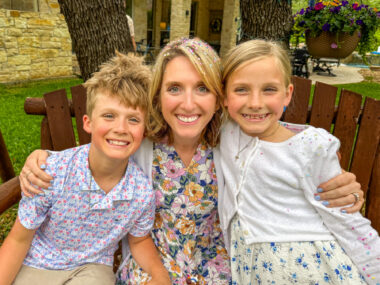
Columnist Kendall Harvey hugs her children, Brooks, left, and Collins. (Courtesy of Kendall Harvey)
While it is so fun to watch her work hard, get stronger and faster, and do something she obviously loves, I can’t help the envy that creeps in. I so desperately want to run with her. I love running, and I resent FA for taking it away from me.
However, running isn’t in the cards for me right now. As I work to make peace with my lot in life, I am reminded that I remain blessed with countless opportunities, choices, and abilities. I choose to lean into my new role and be the best mom in a wheelchair I can be, so my children will be happier and healthier contributors to society.
My mom describes some people as having the beautiful ability to bloom where they’re planted. I’m not sure what the divine plan is for planting me in a body with limited physical abilities, but I choose to try to bloom here.
“I have told you these things so that you will be filled with my joy. Yes, your joy will overflow!” — John 15:11
Note: Friedreich’s Ataxia News is strictly a news and information website about the disease. It does not provide medical advice, diagnosis, or treatment. This content is not intended to be a substitute for professional medical advice, diagnosis, or treatment. Always seek the advice of your physician or another qualified health provider with any questions you may have regarding a medical condition. Never disregard professional medical advice or delay in seeking it because of something you have read on this website. The opinions expressed in this column are not those of Friedreich’s Ataxia News or its parent company, Bionews, and are intended to spark discussion about issues pertaining to Friedreich’s ataxia.



Leave a comment
Fill in the required fields to post. Your email address will not be published.