
AAC 2026: Ataxia conference ends with laughter and empowerment
Comedian with FA uses bold humor to advocate for change
Written by |




A hotel ballroom in Orlando filled with laughter as comedian Fiona Cauley performed at the banquet on the final night of the 2026 Annual Ataxia Conference (AAC). The audience responded enthusiastically to her set, which drew on personal experience.
Cauley, who is living with Friedreich’s ataxia (FA) and uses a wheelchair, has achieved notable success in a profession that can present barriers to women with disabilities.
Her comedy is often rooted in experiences that range from unpleasant to painful. She transforms them into bold, punchline-heavy material that empowers others and invites reflection.
In an interview with Friedreich’s Ataxia News at AAC, Cauley discussed her successes, challenges, and hopes.
From a house party to the ‘Tonight Show’
Cauley, who was diagnosed with FA at 18, thought she’d be a graphic designer. Then, one day, after Cauley had gone through a bad breakup right before Valentine’s Day, her friend decided to throw an anti-Valentine’s Day party.
The plan was a house show with band performances. Cauley was stunned to find her name on the event’s flyer.
Her friends had been encouraging her to do comedy, but she had severe stage fright and thought her dark humor wouldn’t resonate. Now she had no choice: She had to show up for her first performance.
Though her anxiety persisted, the show went very well. Cauley was hooked on comedy.
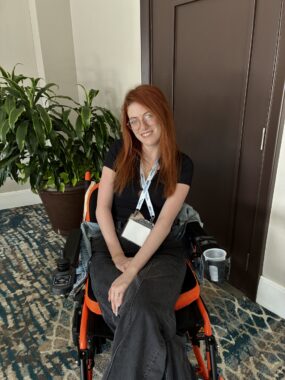
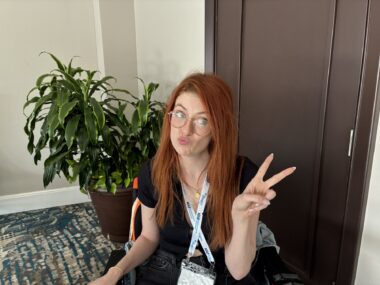
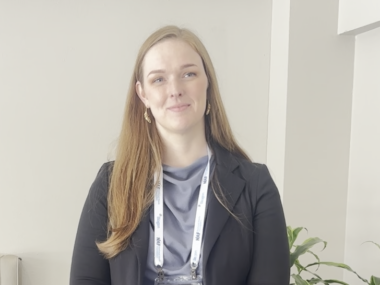
Fiona Cauley, at AAC, finds the humor in living with FA. (Photos by Agata Boxe)
While still navigating stage fright, she tried some open mics, and eventually booked her first paid show. She’s been performing ever since.
She now also cohosts her own YouTube podcast, “Rampin’ Up,” with her beloved husband Matt Taylor, also a comedian.
“That’s my favorite thing in the world,” she says of working with her spouse. “We have so much fun.”
She has also toured with Nikki Glaser and appeared on “The Tonight Show Starring Jimmy Fallon,” as well as on the popular comedy podcast “Kill Tony.”
Perhaps most important, Cauley has been able to make a living through comedy — an unattainable accomplishment for many others in the field.
Life as inspiration for comedy
Sometimes, life truly can be stranger than fiction. It can be especially surreal for people with rare diseases, who often encounter a lack of awareness and understanding.
Cauley has had her share of upsetting experiences that have shaped her work.
“I’ve never had to make anything up just because living life as a disabled young woman, it’s fruitful with content,” she said.
She’s had to deal with odd questions, reactions, and assumptions, including those about her voice, which is affected by FA.
One unfortunately common misconception about people with FA is that they are drunk. This incorrect perception stems from FA symptoms, such as speech changes and difficulties with coordination.
For instance, when Cauley walked into a bar on her 21st birthday, the bartender refused to serve her. Cauley attempted to explain that she had FA, but he was dismissive.
“He laughed at me and was like, ‘Yeah, I’ve heard that one before,’” Cauley said.
Navigating challenges and hoping for change
Although Cauley has found joy and success in her work, she has also faced challenges as a female comedian with a disability.
“It’s hard to decide if being disabled is more of a challenge or being a woman,” she said, “because comedy is such a male-dominated field.”
Earlier in her career, she encountered discouragement from male comedians. “They were like, ‘You’re not going to get anywhere if all you do is talk about being in a wheelchair,’” she said. “I’m like, ‘Well, everything I do, I do from the wheelchair.’”
She’s also had uncomfortable interactions during meet-and-greets. “People try to kiss me a lot,” Cauley said. Others want to sit on her lap.
Cauley thinks that this bizarre behavior stems from a perception of her as someone who’s not a whole person because she’s disabled.
“People see me [as] more childlike … and they think they’re allowed to do whatever,” she said.
Cauley has also dealt with accessibility challenges at some venues. One time, she got stuck alone in a freight elevator. (There were no standard elevators on site.)
At another venue, she learned upon arrival that the elevator was broken. She then found out it was always broken. She had to be carried up two flights of stairs.
The same accessibility issue had further consequences. The staff turned away a woman with FA who had driven two hours with her sister to see Cauley’s show. Cauley was furious.
That said, she has seen some slow progress in select places. Some clubs have installed ramps after noticing her navigating accessibility issues.
She hopes these changes will eventually lead to greater representation of disabled comedians. They need accessible spaces to perform, she says.
For me … it’s more than just comedy.
She would also like for there to be a change in how people with disabilities are seen and treated.
“I want people not to be freaked out by people having different voices or different levels of mobility,” she said.
Meanwhile, Cauley continues her work to challenge assumptions about disability and advocate for a more accessible and understanding world. “For me,” she said, “it’s more than just comedy.”
Note: The Friedreich’s Ataxia News team is providing live coverage of the 2026 Annual Ataxia Conference April 9-11 in Orlando, Florida. Go here to see the latest stories from the conference.

Leave a comment
Fill in the required fields to post. Your email address will not be published.