

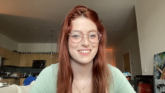




Christian Maugee, a PhD student living with Friedreich’s ataxia, shares how his diagnosis shaped his path in science. Diagnosed at age 9, he reflects on partnering with Biogen and the National Ataxia Foundation, working alongside Bill Nye the Science Guy, and using lived experience to guide his research. He encourages others in the FA community to focus on possibility and progress.
Transcript
Hello. My name is Christian Maugee. I currently live in Gainesville, Florida, where I go to the University of Florida, but I’m from Fort Lauderdale, Florida.
I was diagnosed with Friedreich’s ataxia at the age of 9 along with my twin sister, but I was diagnosed asymptomatically, only genetically. And then by age 14 is when I started experiencing symptoms.
I’ve always loved science, so it’s sort of serendipitous that I was able to join a PhD program later in my life and study the disease that I have.
So I partnered with Biogen, the National Ataxia Foundation, and Bill Nye the Science Guy to work in Bill Nye the Science Guy’s lab, to help raise awareness for ataxias and Friedreich’s ataxia specifically.
I was actually given this opportunity due to my involvement in the community and specifically in the scientific community, since I am also a PhD student studying Friedreich’s ataxia.
So the partners reached out to me, and then I was able to join Bill Nye on screen to help cover and raise awareness about FA.
It was very surreal working with Bill Nye the Science Guy because even though, as scientists, it truly made me feel like a scientist being in his lab and working alongside him. Even though I technically already am a scientist.
So living with Friedreich’s ataxia informs my research by making me be a little more rigorous and a little bit more astute when it comes to what I’m doing and why I’m doing it.
And I am a little more stringent on what I think is important versus what is not important because I can see what may directly impact an individual living with FA.
I will say science is definitely growing exponentially, as it has for the past few years. And so because of that, I’m very excited about a lot of therapeutic avenues that are being explored and a lot of new therapies that are coming to light and being further explored.
So I am very optimistic when it comes to what the future may look like.
I would tell other people in the FA community to remember not to fixate on things they can’t do, but rather focus all their energy on things that can do, because there’s a lot of things we can’t do, but there’s also a lot of things we can.