
I was transported to a joyful memory while listening to the radio a few days ago. I’m in the home where I grew up, and it’s sunny and cheerful. My sisters, Lisa and Tricia, and I are dancing around the living room, yelling first “I will get by, I will…
Defining Yourself — Jean Walsh

Jean Walsh hails from Massachusetts. You will find a mental health perspective in her writing, reflecting her two mental health graduate degrees. She has years of work experience, the most pertinent being her experience as a grant writer. Jean was diagnosed with Friedreich’s ataxia (FA) when she was 19, and has been an avid FA volunteer since. She is 40 years into her journey with FA and so has a lot of experience to share with her shared FA, rare, and chronic disease communities.
Featured Post
A few days ago, I heard a scientist talk about the randomness of being born. For example, what are the chances of your parents — and all of their ancestors — meeting? Then there’s the sperm that wins the race against millions of others to the egg. It all seems…
About 11 years ago, I visited Voyager Therapeutics. The company was, and still is, working to develop a gene therapy for my disease, Friedreich’s ataxia (FA). My dad joined me on that visit, and we were overwhelmed by the care, respect, and kind curiosity we were shown. It was…
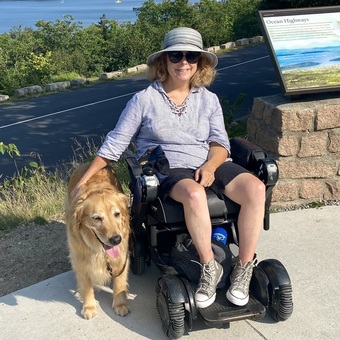
As you read this, I’ll be on my way home to Massachusetts from a family wedding in Georgia. Right now, I’m getting excited about seeing family I haven’t seen in a while. Because I have Friedreich’s ataxia, I use a wheelchair and have a service dog. I hate the…
I sometimes feel afraid to open Facebook. I’m curious about how my friends are doing and what they’re up to, so I log in. Beyond many happy updates, however, I also see that some people in my Friedreich’s ataxia (FA) community are not doing well or have passed away.
Before my neurology appointments, I practiced tasks like touching my forefinger to my thumb, forming the “O” of the “OK” symbol. Part of my exam was, and still is, measuring how quickly I can do that repeatedly. I was determined to excel in my neurological exam. Now, I look back…
Late-onset Friedreich’s ataxia is a rare form of the disease that begins after age 25 and typically progresses more slowly. Though symptoms may be milder, it can still affect balance, speech, and daily life.
Walking my service dog, Wendy, in the winter poses quite a challenge. When I take her out, she’s clipped to my wheelchair, which I use because of my Friedreich’s ataxia (FA). Then she jogs alongside me. Like most dogs, Wendy is thrilled when she knows she’s going out. Wiggling…
On a muggy Fourth of July in Georgia in 1993, my husband, Dave, and I walked along the side of the road, returning to our car after watching fireworks. There weren’t any sidewalks, so I walked on the edge of the road to avoid tripping in the dark while Dave…
Like many of us who get diagnosed with a scary illness, the question of “why me?” ran circles around my head. I chased that voice hard, wondering what I did to deserve Friedreich’s ataxia (FA). The answer I came to and always give that voice in my head is…
When I was diagnosed with Friedreich’s ataxia (FA) in 1981, I was a sophomore in college. I lived in a newly renovated dorm that was wheelchair accessible, and, naturally, a woman who used a wheelchair lived with us. I did everything I could to avoid her. I remember heading…
My husband, Dave, and I had a tough year in 2023, when Dave lost both parents. Our grief has lessened, but we’re still working through it. At times our ability to grieve was blocked because Dave and his siblings were trying to figure out what each parent would’ve wanted in…
Unsurprisingly, after steering my wheelchair into a wall for the fifth time that day, I found myself amid a temper tantrum. For me, these usually involve yelling curse words at Friedreich’s ataxia (FA), the disease I have. In this particular meltdown, I wanted to ram my wheelchair into the…
Explore more columns
 Discussion
 Discussion
 Discussion